Out of Office: Sheldon Cockburn
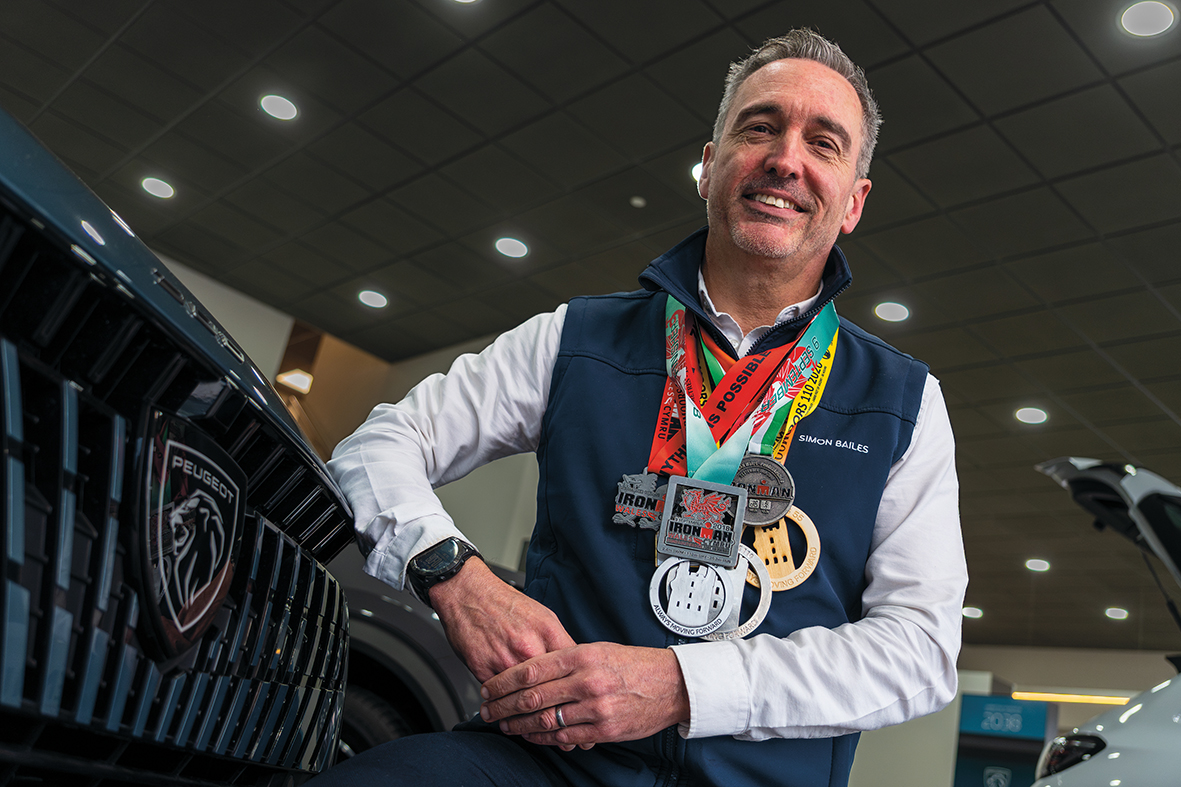
In the latest instalment of a series exploring businesspeople’s lives beyond the workplace, Steven Hugill speaks to Sheldon Cockburn, head of operations at Northallerton, Stockton and Guisborough-based car dealership Simon Bailes Peugeot, about his passion for endurance pursuits, pushing through the pain barrier to represent Team GB and the punishing peaks he continues to pursue.
January 19, 2026
When you’re not helping drive Simon Bailes’ progress as the company’s head of operations, you’re conquering Ironman triathlons and ultra-marathon challenges.
What sparked your passion for endurance competition?
A comment from my wife gave me a wake-up call about my fitness.
She asked me if I was out of breath after putting my socks on – and I was!
I started running the next day, and I couldn’t make it more than 100 metres without gasping for air.
I’d previously bumped into a friend, who was shocked to see how much weight I’d gained after years of losing touch.
I remembered him telling me he was competing in Ironman triathlons: a 2.4-mile swim, a 112-mile bike ride and a 26.2-mile marathon.
I thought he was mad.
However, before I knew it, I’d lost five stone in five months and had signed up for my first triathlon.
I then increased the race distances and, three months later, I found myself signing up for Ironman Lanzarote, which I’d been told was the most difficult of all the Ironman events.
Your event CV is extensive, with five Ironman contests forming just part of a much larger résumé.
Is there one contest that stands out as having pushed you to your limits?
I’ve competed in five Ironman competitions and more than 100 other challenges and events.
The one that really stands out as pushing me to my limit was a non-stop, 110-mile run along the entire Cleveland Way, which I completed in less than 30 hours.
I was physically and mentally exhausted, sleep deprived and aching everywhere, but I was determined to finish.
I attempted it again a year later, and things were going well until I started suffering with dehydration and struggled to walk in a straight line at around 68 miles.
I spotted two bears fighting in the woods as I came down a hill – except I didn’t.
I was totally hallucinating.
My friend and support runner made me call it a day.
The thing I’m most proud of is representing Team GB triathlon, which I did in 2015 in Madrid for the European Championships, and in Ottawa in 2013 for the World Championships, where I ranked 11th in the world.
Not bad for someone who was knackered going up the stairs a few years earlier!
How do you balance your career with event training without burning out, and what does a typical week look like?
I’m at work from 8am until 6pm during the week, and train four times a week in a fairly structured fashion.
I use the same energy gel sachets I would use in a race and I take in the right amount of carbs to prevent me running out of fuel.
The time I spend training really helps me to unwind and recharge, and although I’m still thinking about work, I do so in an entirely different way.
The change of environment, and having something else going on, helps me think about things in a bigger way.
I regularly head into the office the next day energised and ready to tackle whatever issue was troubling us the day before.
What tests you more – the intensity of a competition or the months of grinding preparation?
The day of a competition is the culmination of a lot of hard work, and is about implementing everything you’ve practiced and perfected for 20 hours a week for months beforehand.
You constantly push yourself to the brink during training, so you know your limits and do better each time.
When it comes to the day of a competition, you go out there knowing you can do it, and the sense of achievement when you cross the finish line is unparalleled.
It makes every sore morning worth it.
The parallels between sporting and business success are very close, with one often informing the other.
Are there any lessons from endurance sport that help shape your day job?
During my first Ironman in Lanzarote, there was a lot of uphill cycling.
The thing that kept me going was knowing that the downhill section was going to be much easier, and that I could enjoy the beautiful views on the descent.
It was stunning, and made the hard work of getting to the summit worth every painful pedal revolution.
The uphill is always a challenge, but you have to persevere.
Once you’ve accomplished the toughest part – found the solution, fixed the problem, dealt with the issue – you can take a moment to enjoy your success.
Is there an event or feat of endurance you’d really like to complete before you hang up your triathlon suit?
I plan to keep going until I can’t anymore!
I’ve not taken part in a triathlon for a while, and I would really like to complete Ironman Lanzarote again.
I’ve completed Ironman Wales three times, so I think I’m done there.
I plan to run Wainwright’s Coast to Coast route between St Bees, in Cumbria, and Robin Hood’s Bay, in North Yorkshire, at some point in the next few months, which will be my longest run yet at almost 200 miles.
My ultimate goal, which I’d like to complete when I’m 55 in a few years, is the Montane Spine race.
It’s a gruelling 268-mile run held in January over the Pennines with lots of snow!
January 19, 2026
- Interview