From firm foundations to future growth: Business Durham
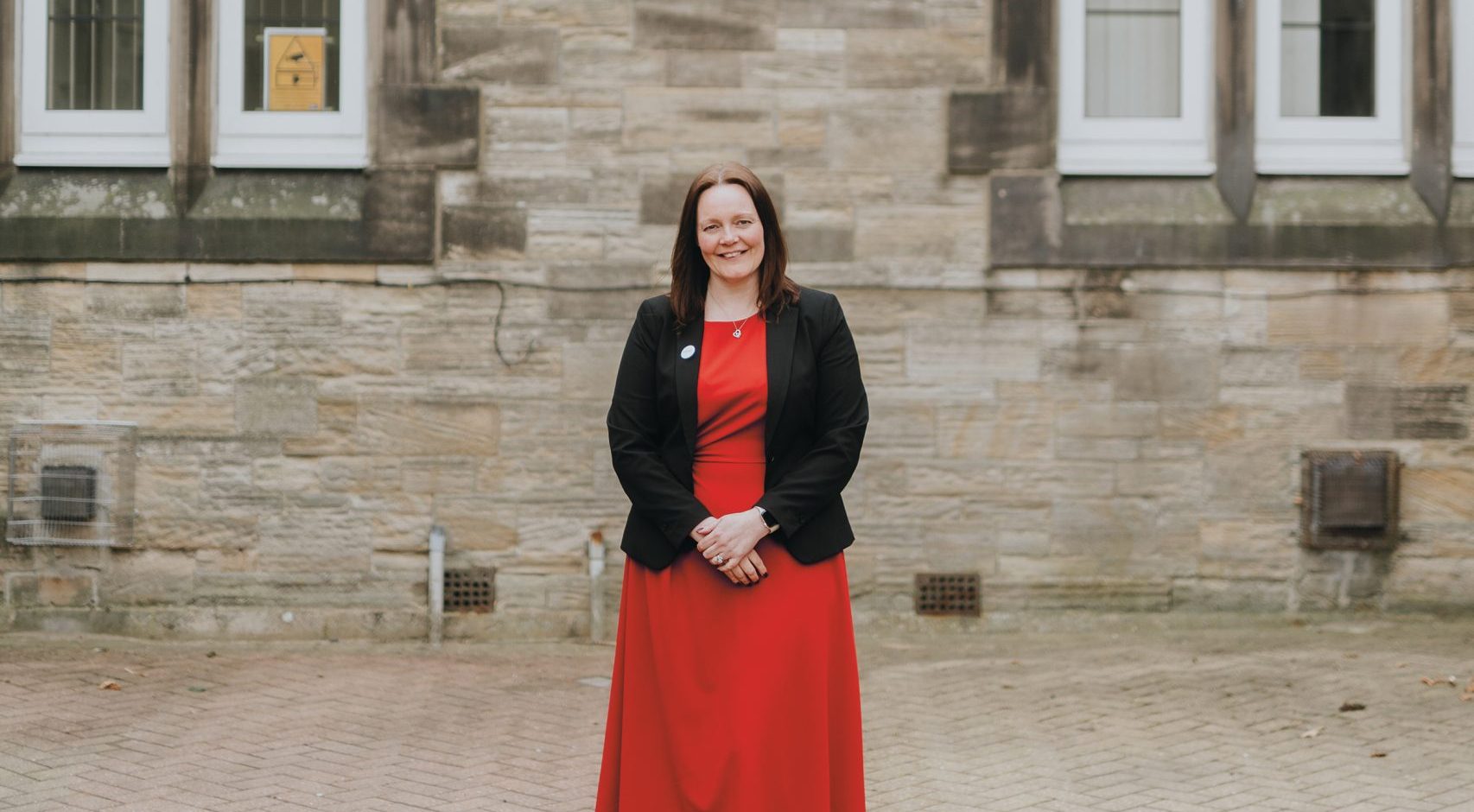
Having recently taken over as Business Durham managing director, Kerry Walker is setting out plans to build on the organisation’s firm foundations. Here, she tells Steven Hugill about the Durham County Council business support service’s backing for companies of all sizes, its provision of platforms for next-generation innovation to thrive and the major investments primed to position Durham – and the wider North East – for lasting success.

May 8, 2026
Business Durham
www.businessdurham.co.uk
Pictures: ROAM, Jamie Haslam
Kerry Walker strides beneath the darkened chiselled letters and numbers of a Victorian sandstone plaque.
At a set of green double doors, she turns right into a grey-blue walkway, continuing on below a rearing lion in a hand-painted crest of the former Crook County Junior School.
Once alive to the sounds of strictness and shuffling feet, the rural Durham building’s labyrinthine corridors today lead the way to an altogether different kind of study.
In high-ceilinged former classrooms, start-up and scaling enterprises are training for growth under the tuition of Business Durham.
The desks and slate boards may have long departed, but the ethos of nurturing potential and laying foundations for long-term success still runs deeply through what is now Crook Business Centre.
“We are a guiding hand and a listening voice,” says Kerry, now sitting inside a teaching space-turned-boardroom.
She adds: “We ensure businesses get the right support at the right time in the right way by building long-term relationships.
“We equip organisations for growth, helping position them so that when opportunities arise – be they support programmes, funding initiatives or supply chain and trade prospects – they are well placed to access them.”
Solid foundations are equally integral to Kerry’s blueprint for the future of Business Durham, the Durham County Council business support service she began leading at the start of April, having switched from the role of business growth director to succeed the retiring Sarah Slaven.
She says: “Business Durham has fantastic foundations; it has a committed team that delivers the best service for businesses and communities.
“Our fundamentals are right, and we made them stronger recently by rolling out a hub-and-spoke-style distributed delivery service, which places business support and property teams within their local geographies to bring services closer to organisations.
“But we are committed to strengthening our offer yet further to remain fit for the future.”
That forward-planning approach, says Kerry, will be supported by Business Durham’s bricks-and-mortar estate that provides homes for organisations stretching from multinational operators to nascent SMEs.
Alongside Crook Business Centre, its portfolio includes Aykley Heads’ Salvus House; Jade Business Park, in Seaham and Rookhope Business Centre, near Stanhope.
The organisation also works closely with partners on key strategic sites such as Forrest Park in Newton Aycliffe – set to welcome a 250-job DPD warehouse – and Connect at Integra 61, in Bowburn, supporting their development and promotion as significant employment and investment locations for County Durham.
Its portfolio additionally includes Sedgefield’s North East Technology Park (NETPark), which boasts tenants such as product development support organisation CPI and SpaceX radio frequency parts supplier Filtronic – and could soon house a proposed £85 million Lockheed Martin satellite factory.
Kerry says: “We work with organisations of all shapes and sizes, as well as businesses looking to invest in the area, and our property portfolio delivers ecosystems where they can flourish.
“NETPark, for example, provides a unique, nurturing environment for like-minded individuals and companies, with incubation and scale-up space complemented by large-scale production capacity.
“It is also home to a Space Enterprise Lab and includes the Compound Semiconductor Applications Catapult and the Satellite Applications Catapult.
“They are two fantastic national centres of excellence operating from the North East,” adds Kerry, who joined Business Durham two years ago after a 20-year career in economic development at Gateshead Council.

The collaborative culture to which she refers extends to Business Durham’s leading role in regional cluster organisations that position the wider North East at the forefront of national moves in the space and advanced material electronics sectors.
She says: “Partnership is embedded in everything we do.
“The region’s industrial heritage provided foundations that have been transformed into modern technology, and we built upon them a number of years ago by identifying emerging sector clusters.”
That work created Space North East England – which is funded by the UK Space Agency and counts the region’s five universities and North East Combined Authority as partners – and North East Advanced Material Electronics.
Kerry says: “These are not solely Durham clusters; we are leading them on behalf of the North East, and they’re important because they represent significant opportunities for existing businesses, those looking to pivot to adjacent sectors and organisations seeking to invest into the region.
“Our inclusive economic strategy takes that further, with a commitment to create jobs at all levels across the varying communities we serve.
“Crucial to that are our partnerships with Durham University and our local colleges.
“They are helping upskill residents and students living in and around the cities, towns and villages we oversee, so they can take on roles and aspire to move into the high-value jobs that are being created.”
A good number of those positions, says Kerry, could soon be based within the Durham Innovation District.
Planned for a ribbon of land that links the city’s existing County Hall site with the nearby Aykley Heads commercial hub and the East Coast Main Line, the multi-million-pound venture promises to deliver 4000 jobs in fresh office and commercial space.
Overseen by a new Durham Mayoral Development Zone, and led by Durham County Council, Durham University and regeneration partner Muse, the endeavour is set to raze the 1960s Brutalist building next year.
Further plans include switching the Durham City Incubator business support programme from Salvus House to the Durham Innovation District, and the creation of a Durham University ‘supercomputer’ data centre at Aykley Heads, which officials say would provide exceptionally fast data processing and complex calculations.
Kerry says: “It’s another fantastic example of the value of our partnerships.
“By working with the wider council and the private sector, we’re accelerating the creation of a business district in the heart of the city.
“It will have a transformational economic impact on Durham and the wider region, and we’re actively seeking businesses to join our thriving community.”
She adds: “We’re on the cusp of something really exciting.
“Durham is truly open for business – open for businesses and open to collaboration to deliver true value for the county.
“I want Durham to become the location of choice for people to start a business, grow a business and invest.
“And with our solid foundations matched by our visionary approach, we’re well on our way to achieving that goal.”
To learn more about Business Durham and how its support programmes could boost your organisation’s progress, visit www.businessdurham.co.uk
May 8, 2026
- Business & Economy
- Promoted