Out of office: Natalie Lonsdale
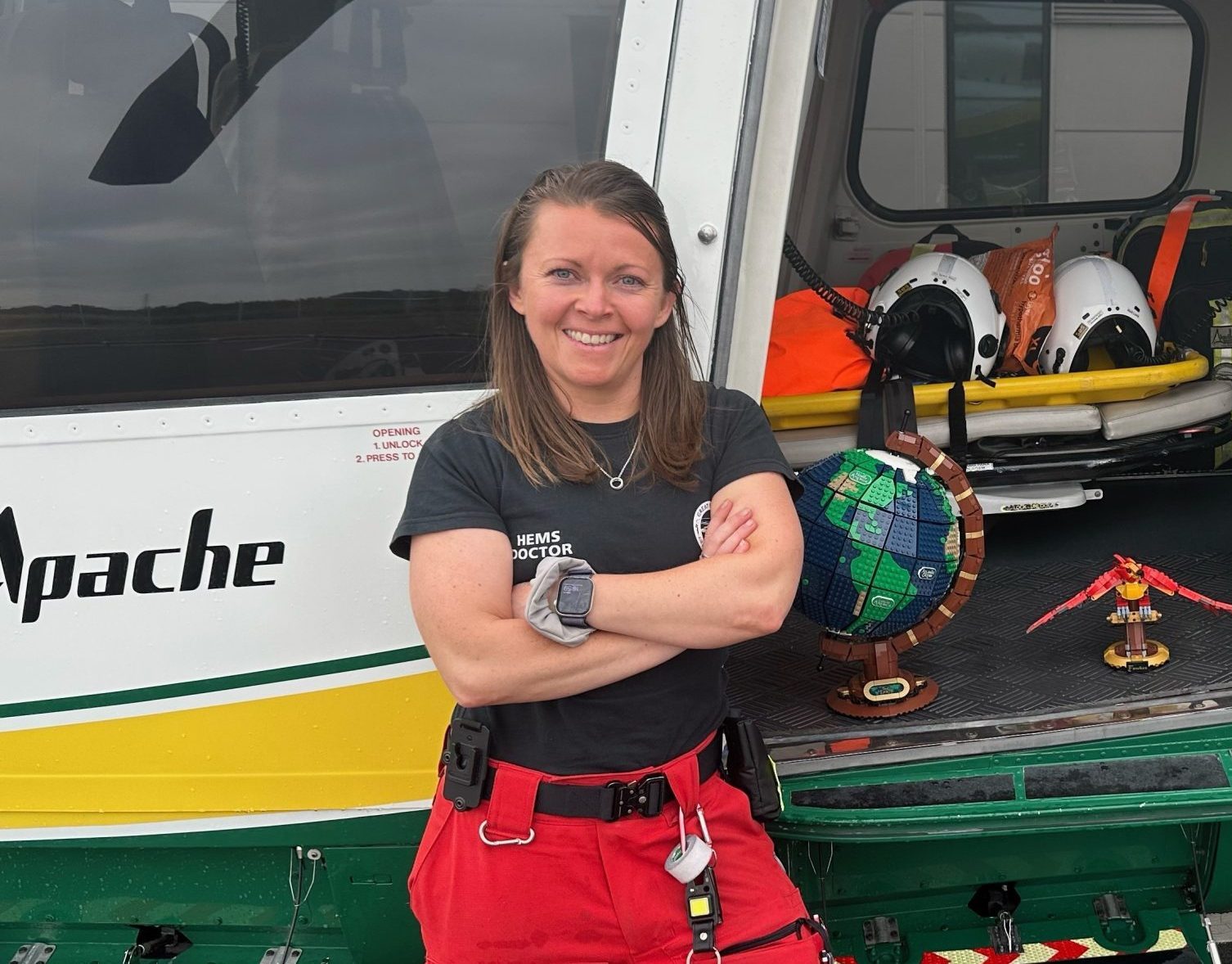
In the latest instalment of a series exploring lives beyond the workplace, Steven Hugill speaks to Great North Air Ambulance Service pre-hospital doctor Natalie Lonsdale, who, when not responding to emergency calls, can be found piecing together intricate LEGO sets. Here, Dr Lonsdale reveals more about her route into medicine, how sibling rivalry ignited her passion for plastic brick modelling and how her hobby provides balance against the intense pressure of saving lives.

November 16, 2026
Great North Air Ambulance
www.greatnorthairambulance.co.uk
Instagram: gnairambulance
You’re a pre-hospital doctor with the Great North Air Ambulance Service. Tell us a little about your role and what a typical shift entails.
We start the day by checking our kit, making sure everything is in the right place and packed in both the car and aircraft.
We then do an aviation brief with the pilot, where we discuss the weather and any potential flying restrictions as a team, followed by a medical brief.
After that, it’s time for a cup of tea and a catch-up with the charity staff.
During the day, we will do some team training that involves reviewing a standard operating procedure for a specific drug before running a simulation.
After that, and between the incidents we get tasked to, we have weekly and monthly jobs to do, in which we check the kit in the bags, making sure the electrical equipment (monitor and ventilator) is charged and serviced, and check our drugs and equipment.
No shift is the same, as we never know how busy we will be or where the jobs will take us.
Alongside your Great North Air Ambulance Service post, you’re also an emergency medicine doctor at Newcastle’s Royal Victoria Infirmary and a Royal Air Force medical officer. What inspired you to pursue a career in medicine, and how do your different roles complement each other?
I can’t really remember the moment I realised I wanted to be a doctor.
I always knew I liked science and interacting with people, so it kind of happened naturally. I tried out a few specialities as a junior doctor, but the moment I stepped into the emergency department, I knew it was for me.
It is relentless, but it’s a fantastic job. You never know what’s going to come through the doors.
The teams I work with are amazing, and share a passion for working hard to help people on their worst days.
My three jobs all work alongside each other really well; my NHS and Great North Air Ambulance Service work prepares me for my military role and ensures I am highly trained and experienced.
My military work then takes me to remote and austere areas, which requires great innovation. We often see the sickest of trauma patients, and I bring those experiences back to my NHS practice to ensure our patients are receiving the highest levels of care.
When you’re not soaring across the region’s skies responding to emergency incidents, you can be found building elaborate LEGO creations. What sparked your passion for miniature plastic brick modelling?
My sister had a Star Wars LEGO set, and so, being the little sister, I obviously had to get my own (although a different model), and from there the passion began.
I started building a collection of sets; the problem with LEGO is that once you start, you need the whole collection, so you can’t stop.
Your job can be intense and emotionally demanding, given the difficult situations you often encounter.
How does sitting down with a LEGO model help restore a sense of balance?
I find LEGO really useful for this, and I think that’s why I have ended up with such a collection and enjoy it so much.
Focusing on the intricacies of where the next brick goes, and making sure you construct it correctly, really helps turn my brain off from everything else.
Going for a run really helps my body physically, but my brain is still on, and I find myself thinking about the patients I have seen or a job list.
However, you can’t do that with LEGO, as you have to focus so much on the instructions and which bricks go where.
LEGO builds don’t always go smoothly – have you experienced any construction disasters or reached the end only to discover a crucial piece is missing?
Thankfully, I have never had a piece missing in a LEGO set.
I did have one disaster a few years ago, though, when I was trying to transport a set and dropped it.
It was great fun trying to work out how to get it all back together again without the instructions.
What do you do when you’ve finished a build – are models put on display, or do you take the pieces apart and put them back in the box?
I should probably put them back in the box, as I am running out of room.
But they all go up on display around the house; many new shelves have had to be built over the years!
Do you have a favourite model you’ve built over the years, and is there a dream set on your to-do list?
It would be very hard to choose a favourite, but if I really had to, it would be Rivendell from The Lord of the Rings.
It had so many features that linked to the book, which made it such fun to build.
November 16, 2026
- Feature