Roundtable: Exporting a region to the world
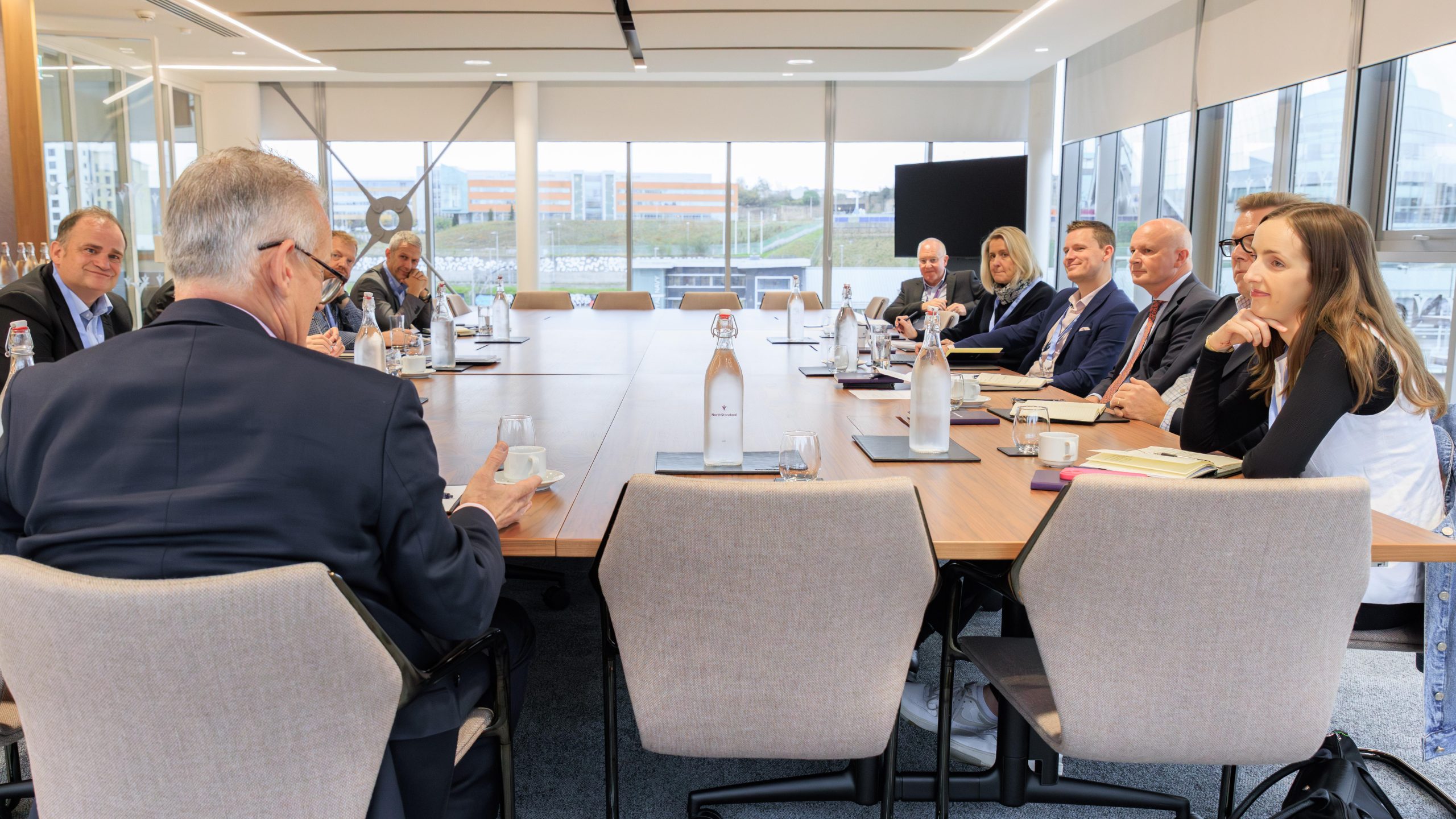
From its three great rivers to its six globally-connected ports, the North East’s towns and cities have long had their identities forged, and their industries built, on water. The landscape along the River Tyne may have changed, but the region’s proud maritime legacy endures. At the heart of it all is Tyneside-headquartered global marine insurer NorthStandard, which provides protection and indemnity cover for one-in-five commercial ocean-going vessels. Here, in an exclusive roundtable discussion hosted by NorthStandard alongside N magazine publisher NET, bosses from maritime, trade, policy and academic organisations explore the North East’s role in international commerce.
Words by Peter Anderson
Photography by Pawel Gajek (The Bigger Picture Agency)
January 19, 2026
Where does the North East stand in today’s international trade landscape?
For centuries, the North East’s fortunes have been tied to trade.
From Sunderland’s shipyards, once the busiest in the world, to the coal and steel that left the Tyne and Tees for markets across the globe, the region has long looked outward.
Today, that legacy endures in a new form.
The North East remains one of the UK’s most export-intensive regions, and while recent figures show a small goods trade deficit, the region continues to outperform most others across the country.
However, Michael Dickinson, North East Chamber of Commerce international trade development and delivery manager, said that while the opportunities are substantial, only a relatively small number of local businesses are engaging globally.
He said: “We have around 5400 exporters and 5900 importers, exporting roughly £15 billion and importing £18 billion.
“Many businesses think trading internationally is too complex or too costly, or simply don’t know where to start.
“We could be doing a lot more as a region.”
Michael found support from Jen Hartley, assistant director of capital investment and growth at Newcastle City Council, who highlighted the region’s overreliance on a small number of large investors and exporters.
She said: “The North East has punched above its weight in attracting major foreign direct investment projects – we’ve had consecutive years ranking highest outside London for jobs created by new foreign investment.
“But that success rests on a handful of companies.
“If we were to lose one of those big companies, then our trade levels would plummet.
“The challenge is how we get more SMEs to adopt an international trade mentality.
“How do we break down barriers to entry, help them deliver effective market strategies and look beyond our borders to the US, as well as to nearby European partners?”
Matt Beeton, Port of Tyne chief executive, added: “From a port perspective, basic trade – imports and exports across the UK – is stable.
“However, with the momentum gained from devolution and new opportunities on our doorstep, there are lots of reasons to be optimistic.
“Investor confidence may be low generally across the UK, but investors engaging with the North East – and with the port specifically – want to invest.”
Where are the North East’s key opportunities to boost trade and exporting potential?
From digital and professional services firms, to a new AI Growth Zone, QTS’ £10 billion data centre in Cambois, creative moves and space sector innovation, the North East is drawing much international interest and investment.
But, as in the region’s past, the key to unlocking future prosperity will also lie at sea.
From the Blyth-based Offshore Renewable Energy Catapult to Equinor, Van Oord and Ørsted’s marshalling, operations and maintenance bases at Port of Tyne, and SeAH Wind’s £900 million wind turbine monopile making plant at Teesworks, the transition to net-zero has created an opportunity for the region to lead from the front.
Phil Witcherley, executive director for economy, innovation and culture at the North East Combined Authority, said: “With the advantages of the North Sea over the Celtic Sea, Dogger Bank and assets such as the Offshore Renewable Energy Catapult, it’s clear we have significant assets.
“When people think of offshore wind, they usually think of North East Scotland or the Humber.
“But if you look at Port of Tyne or Port of Blyth, the scale of activity and the opportunities are even greater.”
However, Paul Jennings, managing director at NorthStandard, highlighted challenges faced by investors, noting that while shipowners support fuel transition, regulatory uncertainty and long-asset lifecycles often prevent them from committing to new solutions.
He said: “The problem is that an investment in a ship is 25 to 30 years.
“And shipowners, even though they believe in the fuel transition, have no idea what fuel those ships will have, or what will be available in the future.
“While I fully back the North East’s push into the clean energy space, we have to be realistic about what’s happening globally.”
Dr Fiona Whitehurst, associate dean for engagement and place at Newcastle University Business School, who is also a member of the Global Underwater Hub’s North Advisory Group, pointed to the scale of opportunity that lies within renewable energy and the wider supply chain.
She said: “The subsea sector has traditionally been associated with oil and gas, but technology and expertise are now being applied across a range of industries, including offshore wind.
“Companies such as Baker Hughes, TechnipFMC, Osbit, JDR Cables and SMD already serve a wide range of global markets, including Europe, the US, Middle East and South America.
“These firms have always been at the forefront of innovation – in cables, trenchers, remotely operated vehicles and all the equipment that sits on the seabed – and that same technology will underpin the next generation of renewable energy projects.”
Jen, speaking after North Shields musician Sam Fender won the Mercury Prize on home soil – pointed to the North East’s strides across a range of other industries.
She said: “It’s about creating a lasting legacy.
“From TV, film and screen to the Northern Centre for Writing and the new Warner Studio in Newcastle, these are industries where we can grow talent locally, support the creative supply chain and show the world the North East is creating the next generation of ideas and technology.
“We need to take all the companies doing amazing things and put them into a narrative that allows people to see the North East is leading the way.”
What are the key barriers holding the region back?
Roundtable members identified perennial barriers preventing the North East from realising its economic potential.
Erin Henwood, international policy manager at business organisation CBI, said: “North East firms face higher borrowing costs than those in London and the South East, and they have access to more limited investment.
“Productivity is low, the labour market is tight, economic inactivity is high and there is the wider issue of fragile trade links.
“However, the problems are solvable.
“If we harness emerging technologies like artificial intelligence and equip people with the right skills, the North East has a real chance to thrive.”
The sentiment was shared by Fiona, who works closely with the Scaleup Institute.
She cited the success of the Venture Connect and ScaleUp Britain event at Port of Tyne, which was co-hosted with the London Stock Exchange and the ScaleUp Institute.
She said: “Our spin-outs and high-tech start-ups, the ones that could really grow and scale, are underfunded.
“Events like ScaleUp Britain show what’s possible – innovative companies pitching ideas, making connections and accessing the right networks.
“These businesses are incredibly talented, but they need funding, support and a platform to be seen.”
Matt reinforced the same point.
He said: “We launched the Venture Connect programme because so many strong small companies were struggling to attract investors to scale.
“The feedback from investors has been fantastic, but it also underlines the challenge – we’re not drawing enough investors to the North East and we need to do more to bring them here.”
Roundtable members also stressed the need to align education with new industries, ensuring the skills needed for emerging sectors are taught and nurtured locally.
While Michael praised universities and colleges for their facilities and support, he pointed towards a significant disconnect at secondary and primary school level.
He said: “Colleges and universities in the region are doing incredible work, but there’s a large gap from secondary schools.
“What students are being taught often isn’t fit for purpose, and many teachers lack work experience in the industries we are trying to grow.
“That gap starts even earlier in primary school, where children rarely get to see the opportunities that exist locally.
“We need to plan for the future and build awareness and skills from the very start, so young people can see what they could achieve in the North East, rather than falling into jobs later on.”
Mike Salthouse, head of external affairs at NorthStandard, said: “I go into schools as part of our Inspiring the Future initiative.
“Children often don’t want to hear about the world of industry or shipping – they just want mock interviews.
“That’s a lost opportunity to show what exciting careers exist, whether in insurance, professional services or beyond.”
How can the North East raise its profile to attract talent, investment and businesses, while breaking down entrenched stereotypes?
The North East has never been short of talent or ambition, but it has often struggled to tell its story.
Roundtable members said while other regions consistently broadcast their successes, the North East often underplays its strengths.
Peter Snaith, partner at Newcastle and Teesside-based international law firm Womble Bond Dickinson and head of the firm’s manufacturing sector group, said the region remains guilty of clinging to a romanticised past.
He said: “We still badge ourselves as the industrial north – but we haven’t been that for a very long time.
“People still think of big, blue-collar jobs, but the North East is full of innovation, services and future-facing industries.
“If we start talking about the North East as a single, powerful collective, we’ll stand a much better chance of competing nationally and globally.”
This is an abridged version of the full roundtable discussion, which you can read by visiting N magazine’s sister publication Bdaily here.
January 19, 2026
- Events